
Why Does AI Hallucinate? Causes, Examples, and Prevention
Why Does AI Hallucinate? Causes, Examples, and Prevention

What Is an AI Hallucination?
AI can hallucinate because it generates answers from learned patterns and available information without automatically checking every statement against reliable evidence. When important details are missing or unclear, it may produce a convincing guess instead of acknowledging uncertainty. For businesses, this can mean invented facts, policies, or references presented as trustworthy information.
An AI hallucination is a statement generated by AI that sounds credible but is false or unsupported by evidence.
For example, an AI assistant might invent a company policy, refer to a report that does not exist, or provide a specific figure without a reliable source. The answer can be clear, detailed, and confident even when the information is wrong. OpenAI's guidance on ChatGPT accuracy describes these kinds of errors.
Not every AI mistake is necessarily a hallucination. An incorrect calculation or an incomplete summary can also be an error. Here, the central problem is that AI presents an unsupported claim as though it were an established fact.
Why Does AI Hallucinate?
Fluent Language Does Not Mean Verified Facts
AI language models learn patterns from large amounts of text. When you ask a question, they use those patterns, together with any information provided in the conversation, to generate an answer.
This process allows AI to produce remarkably natural explanations. But producing a plausible sentence is not the same as checking whether it is true.
A model may generate a specific name, date, or policy because it fits the patterns it has learned, even when there is insufficient evidence to support that detail. Without an additional verification process, a convincing answer can still be incorrect.
Missing or Unclear Information Creates Gaps
AI cannot reliably determine facts that are unavailable to it simply from how a question is worded.
For instance, a company's internal policies may differ from common industry practices. If an assistant has no access to the relevant company documents, it may produce an answer that sounds reasonable but does not reflect the actual rules.
Outdated information and ambiguous questions introduce further risks. Even when some relevant information is available, the AI may rely on an obsolete rule, overlook an important condition, or fill a gap with an unsupported assumption.
AI May Guess Instead of Acknowledging Uncertainty
Another contributing factor is how language models are trained and evaluated.
In its 2025 research, OpenAI explains why language models hallucinate and how common evaluation methods can reward guessing rather than admitting uncertainty.
Consider a student taking a test where a correct guess earns points, while leaving an answer blank earns nothing. Such a system can encourage guessing even when the student is unsure.
This is an analogy, not a description of AI consciously making decisions. But it illustrates why a system optimized to provide answers may sometimes generate a specific response when it lacks enough information.
The important distinction is that a confident answer is not necessarily a well-supported answer.
AI Hallucination Examples in Business
Imagine a retail company using an AI assistant to answer customer questions about returns.
This is a hypothetical example, not a documented business incident.
The company's approved policy states that unopened items may be returned within 14 days of purchase.
A customer contacts support and asks whether they can return an opened item purchased 25 days ago.
The AI assistant responds:
"You can return any item within 30 days of purchase."
The answer sounds helpful and straightforward. But the assistant has invented a rule that the company's policy does not support.
The problem is not simply that the AI gave an incorrect number. It presented an unsupported promise as an official company policy.
What should happen instead?
The assistant should consult the current approved policy and check whether it actually covers the customer's situation.
In this case, the available rule applies to unopened items returned within 14 days. It does not establish whether an exception is possible for an opened item after 25 days.
A more responsible response would be:
"Our standard policy covers unopened items returned within 14 days. I can't confirm whether your return qualifies, but our support team can review your request."
This answer does not invent an exception or make an unsupported promise. It communicates what is known and leaves the unresolved decision to someone authorized to make it.
Hallucinations can also appear in less obvious forms. An AI assistant might cite a report that does not exist or introduce an unsupported financial figure into a management summary. In each case, the information may look credible enough to be accepted without further checking.
Why Hallucinations Matter for Business
An incorrect AI-generated answer is not always a serious problem. The consequences depend on where the answer is used, who relies on it, and what happens next.
Consider three business situations:
- Customer support: A fabricated policy may create false expectations, damage customer trust, and require employees to resolve avoidable disputes.
- Business reporting: An invented statistic or unsupported claim may influence a manager's assessment of performance or lead to a poor decision.
- Automated operations: In AI automation workflows, an incorrect AI output may be passed to another software step. If the system acts without appropriate approval, it could trigger an inappropriate refund, update a business record, or initiate another unintended action.
The same type of error can therefore have very different consequences.
A mistaken answer in an internal draft may be caught during review. A similar error sent directly to thousands of customers could be much harder to correct. When an AI agent acts on an unsupported answer, the consequences may extend beyond misleading information.
This is why AI reliability is not just about choosing a more capable model. Businesses also need to consider the importance of each task, how much authority the AI receives, and what safeguards exist when an answer is wrong.
The NIST Generative AI Risk Management Profile provides a voluntary framework for organizations to address generative AI risks throughout the design, deployment, use, and evaluation of AI systems.
The business goal is not merely to generate better answers. It is to prevent unreliable answers from becoming costly decisions or actions.
How to Reduce AI Hallucinations
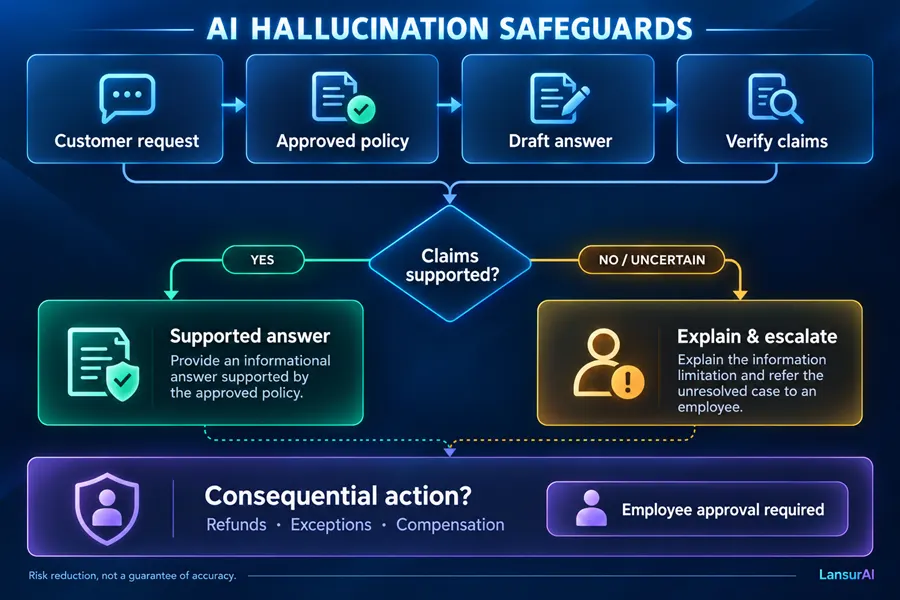
Businesses cannot prevent every AI hallucination. A practical approach combines several safeguards: providing reliable information, checking whether answers are supported, allowing uncertainty, testing difficult situations, and requiring human approval for consequential actions.
1. Give AI Trustworthy, Up-to-Date Information
Instead of expecting an AI assistant to know your company's rules, provide the relevant information when it needs to answer a question.
For our hypothetical retail business, this means giving the support assistant access to the company's current, approved returns policy.
The company should designate which policy is authoritative, assign responsibility for keeping it updated, and remove or clearly mark outdated versions. When a customer asks about returns, the assistant should consult the relevant policy rather than rely on general knowledge about how other retailers operate.
When an AI system retrieves relevant information from external sources to help generate an answer, this approach is called retrieval-augmented generation (RAG). Google Cloud explains how RAG works and how it can provide language models with relevant, up-to-date information.
For businesses, the benefit is straightforward: an assistant can work with company-specific facts that may not be part of its original training.
However, access to documents does not guarantee accuracy. The assistant may retrieve an outdated version, miss a relevant passage, or misunderstand an important condition. Providing the right information is only the first safeguard.
2. Check That the Answer Matches the Source
Giving AI access to a reliable document is not enough. The next step is to check whether the answer is actually supported by what that document says.
Return to our example. The approved policy covers unopened items returned within 14 days. But the assistant claims that any item can be returned within 30 days.
A comparison reveals two problems: the assistant changed the time limit and removed the condition that the item must be unopened.
Even if the assistant included a link to the real policy, that link would not make its answer correct.
Businesses should therefore check important statements against the relevant passages in their approved sources. This includes specific figures, dates, conditions, exceptions, and promises made to customers.
The relationship between an AI-generated claim and the information supporting it is often called grounding. Google Cloud's grounding documentation describes checking individual claims against reference information. Microsoft's RAG evaluation guidance also distinguishes finding relevant documents from checking whether an answer is supported by them.
For our retail assistant, the practical rule is simple: it should not promise a 30-day return when the approved policy does not support that promise. Nor should it invent a decision about an exception that the policy does not explain.
These checks can help identify unsupported statements before they reach customers. But they have limitations. Automated checks can miss errors, and an answer can accurately reflect a document that is itself outdated or incorrect.
Reliable AI answers require both trustworthy sources and careful use of those sources.
3. Make "I Can't Confirm That" an Acceptable Answer
Sometimes an AI assistant simply does not have enough information to give a reliable answer.
In these situations, the safest response may be to acknowledge the limitation rather than make a guess.
In our returns example, the available policy does not establish whether the customer's request qualifies.
Instead of inventing an exception or rejecting the request without sufficient evidence, the assistant should explain what the policy confirms and offer to refer the case to a support employee.
Businesses should make this behavior an explicit part of their AI support process. An assistant should be allowed to say that it cannot confirm an answer, ask for clarification, or transfer a request when the available information is insufficient.
This matters because AI systems do not always handle uncertainty reliably. As OpenAI's research on hallucinations explains, some common evaluation methods encourage models to guess rather than acknowledge what they do not know.
However, instructing AI to admit uncertainty is not a complete safeguard. The assistant may fail to recognize that its information is insufficient. Businesses still need to test whether it handles uncertain situations correctly.
4. Test the Assistant with Ordinary and Difficult Questions
Before allowing an AI assistant to communicate with customers, businesses should test how it responds to realistic situations.
The goal is not only to confirm that AI answers straightforward questions correctly. It is also to discover what happens when information is missing, unclear, or contradictory.
For our hypothetical returns assistant, a useful set of tests would include:
- A routine request: An unopened item purchased 10 days ago. Does the assistant apply the standard policy correctly?
- An uncertain request: An opened item purchased 25 days ago. Does it recognize that the available policy does not establish eligibility?
- A nonexistent exception: A customer asks about a special return rule that is not documented. Does the assistant avoid inventing one?
- An outdated policy: An older version contains different return conditions. Does the assistant use the current approved version?
For each test, the business should examine both the information the assistant used and the answer it produced. Unsupported statements and failures to refer uncertain cases to staff should be recorded and addressed.
This reflects an important distinction in Microsoft's guidance on evaluating AI systems that use reference documents: finding relevant information and producing an answer supported by that information are separate quality checks.
Testing should also continue after deployment, especially when company policies change or new types of customer requests appear.
Passing a collection of tests does not guarantee that every future answer will be correct. Real customers may ask questions that the business never anticipated.
5. Keep People Responsible for Consequential Decisions
An AI assistant may be useful for answering routine questions, but not every decision should be left to automation.
When an incorrect answer could create a financial obligation, affect a customer, or change an important business record, the company should define when human approval is required.
For our retail business, the assistant could explain the standard returns policy. But requests for undocumented exceptions should go to an authorized employee.
The company could also require staff approval before an AI system issues refunds, grants exceptions, promises compensation, or performs other consequential actions.
This does not mean employees must manually approve every routine answer. It means the level of human involvement should reflect the consequences of a potential mistake.
OpenAI's safety best practices recommend human review, particularly for high-stakes uses, and emphasize that reviewers should have access to the information needed to verify AI-generated outputs.
Human oversight also has limitations. Employees can overlook errors, especially if they cannot see the original documents or do not have clear authority to challenge an AI recommendation.
Effective oversight requires more than a person approving a result. Reviewers need reliable information, clear responsibilities, and the ability to correct or reject an AI-generated decision.
Together, these safeguards create a practical process: provide approved information, verify important claims, acknowledge uncertainty, test how the assistant behaves, and keep people in control of consequential actions.
Can AI Hallucinations Be Eliminated?
No method can guarantee that an AI system will produce accurate answers in every situation.
More capable models, clearer instructions, and access to reliable documents can reduce certain types of errors. But AI may still misunderstand information, overlook an important condition, or repeat an error found in its sources.
For businesses, it is useful to distinguish three different goals:
- Reduce the chance of errors: Provide relevant, up-to-date information and clear instructions.
- Detect errors: Check important AI-generated claims against reliable evidence before relying on them.
- Limit the consequences: Allow the assistant to acknowledge uncertainty, escalate unresolved questions, and require human approval for consequential actions.
These safeguards address different parts of the problem. None guarantees perfect accuracy, even when several are used together.
The practical goal is not to make AI infallible. It is to build a process in which unreliable information is less likely to reach customers, influence decisions, or trigger actions without appropriate checks.
Key Takeaways
- Fluent does not mean factual. A confident, well-written AI response can still contain invented or unsupported information. Verify important claims rather than relying on how convincing they sound.
- Provide reliable information and check how AI uses it. Approved sources help reduce unsupported answers, but the actual claims must still match the evidence. Test the assistant with both routine and difficult situations.
- Keep the consequences under control. Make uncertainty and escalation acceptable, and involve employees when an AI-generated answer could lead to a costly or consequential action.