
What Is an AI Agent? How AI Agents Work and Business Examples
What Is an AI Agent? How AI Agents Work and Business Examples

What Is an AI Agent?
An AI agent is a software system that uses AI to pursue a goal, decide what to do next, and use tools to complete tasks within defined limits. For businesses, this means an agent can do more than answer questions: it can retrieve information, interact with applications, and help move a task toward completion.
For example, a basic chatbot might explain a company's refund policy. An AI agent could go further: look up a customer's order, check relevant information, and prepare a refund request for approval.
The key difference is the ability to select and carry out actions based on the situation, rather than only generating a response or following a fixed sequence of instructions.
Modern AI agents often use large language models (LLMs) to interpret information and guide their actions. However, the model alone is not the entire agent. Tools, context, and operational safeguards are also important parts of the system.
How Do AI Agents Work?
AI agents combine the ability of AI models to interpret information with tools that allow software to interact with external systems.
Instead of requiring every step to be specified in advance, an agent can determine the next appropriate action based on its goal, available information, and operating rules.
The Core Components of an AI Agent
Modern LLM-based agents typically rely on four main elements:
- AI model: Helps the agent understand requests, interpret available information, and select the next step.
- Tools: Connect the agent to external systems, such as databases, CRM platforms, or order management applications. Tools allow it to retrieve information or perform authorized actions.
- Instructions and guardrails: Define the agent's responsibilities, expected behavior, and operating boundaries.
- Context: Provides the information needed for the current task, including user requests, relevant records, and results from previous actions.
These components work together, but they serve different purposes.
For example, instructions might tell an agent not to issue refunds without approval. However, instructions alone cannot guarantee that this rule will be followed. Actual enforcement requires technical permissions, system-level restrictions, and independent checks.
How an AI Agent Completes a Task
A typical agent works through a sequence of steps:
- Receive a goal. A user or business system requests an outcome, such as resolving a customer complaint.
- Gather context. The agent identifies what information it needs and retrieves relevant data.
- Choose an action. It determines the next step and, when necessary, selects an available tool.
- Check the result. It examines the response from the tool or external system.
- Continue, finish, or escalate. Based on the result, the agent takes another step, completes the task, or requests human assistance.
This repeating process is commonly called an agent loop.
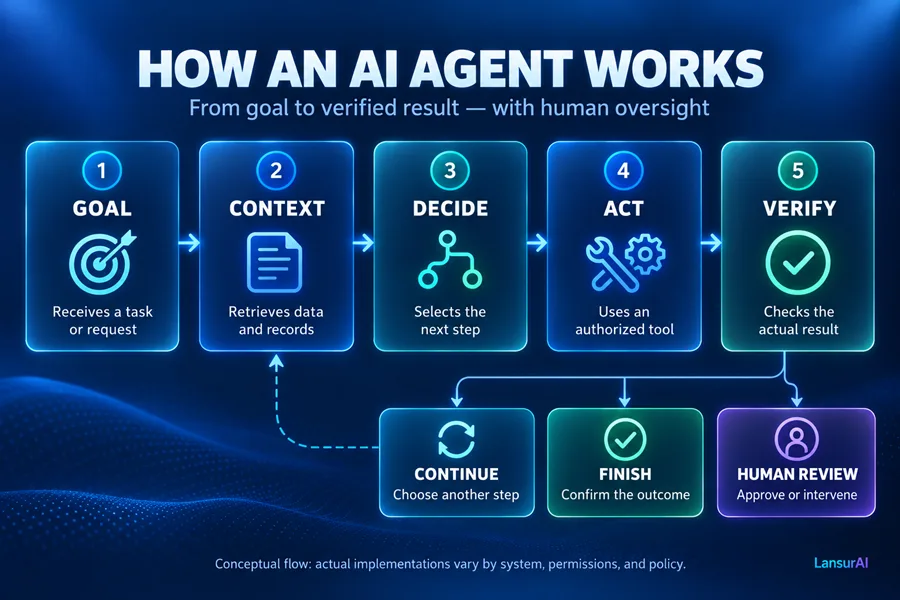
Unlike traditional automation, where the execution path is determined by predefined rules, an AI agent can use a model to select its next action based on changing circumstances.
The degree of autonomy varies. Some agents only recommend actions, while others can execute approved operations. Not every agent requires long-term memory or unrestricted access to business systems.
Example: How an AI Customer Support Agent Handles a Refund
Consider a hypothetical online retailer receiving customer requests about deliveries, returns, and refunds.
A customer sends the following message:
"My order arrived damaged. Can I get a refund?"
A basic chatbot might provide a link to the return policy. An AI agent connected to the retailer's business systems could help handle the request through several coordinated steps.
Step 1: Understand the Request
The agent recognizes that the customer is reporting a damaged item and requesting a refund. If the order cannot be identified, it asks the customer for additional information.
Step 2: Retrieve Relevant Information
Using authorized tools, the agent retrieves the order details from the company's order management system. It can check information such as the purchase date, delivery status, and applicable return policy.
Step 3: Evaluate the Available Options
The agent examines the available information and identifies an appropriate next step. If the order appears to satisfy the company's refund criteria, it can prepare a proposed resolution. If the information is incomplete, inconsistent, or outside the supported policy, it can request clarification or escalate the case. The company's business rules and authorization controls still determine which actions are permitted.
Step 4: Request Approval When Required
Suppose the retailer requires employee approval before issuing refunds. The agent prepares a recommendation and submits it for review rather than initiating a payment operation independently. Once an authorized employee approves the request, the system may permit the agent to execute the approved action through a designated tool.
Step 5: Verify the Outcome
After an action is attempted, the agent checks the relevant system to determine whether it succeeded. If the refund is confirmed, the agent can inform the customer. If the result is uncertain, the agent should request further verification instead of assuming that the operation succeeded.
What Makes This an AI Agent?
The agent isn't simply generating a response or following a fixed script. It interprets the customer's request, determines what information is missing, chooses appropriate tools, and adapts its next steps based on the results. For the retailer, the potential value is reducing repetitive information gathering and helping employees handle requests more consistently. However, the actual benefit depends on reliable integrations, accurate information, appropriate safeguards, and the quality of the implementation.
AI Agents vs. Chatbots and Traditional Automation
AI agents, chatbots, and traditional automation can all support business processes. Their main differences concern how they select actions and respond to changing information.
| Capability | Basic FAQ Chatbot | Rule-Based Automation | AI Agent |
|---|---|---|---|
| Primary purpose | Answer questions | Execute predefined processes | Work toward a defined goal |
| Handling different inputs | Responds to supported questions | Applies programmed conditions | Interprets varying information and context |
| Choosing the next step | Limited conversational logic | Follows predefined branches | Uses an AI model to help select actions |
| External actions | Usually limited or unavailable | Uses predefined integrations | Uses available, authorized tools |
These categories are not mutually exclusive. An AI agent may use a chat interface, while an advanced chatbot can include agent capabilities. Similarly, real-world systems often combine AI-driven decisions with deterministic workflows. The distinction is practical rather than absolute.
The objective isn't to replace every chatbot or automated process with an AI agent. It's to choose the approach that solves the task reliably without introducing unnecessary complexity.
Business Examples: Where Can AI Agents Help?
Beyond customer support, AI agents can assist with processes that involve information from multiple systems and decisions that vary between cases.
Sales Operations
Sales representatives often spend time reviewing customer histories and preparing follow-up messages. An AI agent could gather relevant CRM information, draft a personalized follow-up, and propose record updates for approval.
Potential value: Less repetitive preparation work, while employees retain control over customer communications and important CRM changes.
Internal IT Support
Employees report technical problems with different symptoms, descriptions, and levels of urgency. An agent could interpret a support request, search internal documentation, gather permitted diagnostic information, and either perform approved low-risk actions or escalate the issue.
Potential value: More consistent initial investigation and reduced manual effort for routine support requests.
Operations Reporting
Managers often need reports assembled from several business systems. An agent could retrieve available data, identify missing information, and prepare a structured report for review.
Potential value: Less manual coordination and report preparation, provided important figures are verified against reliable sources.
These are illustrative scenarios rather than documented deployments. Their success depends on the workflow, system integrations, data quality, and operational controls.
When Should a Business Use an AI Agent?
A business should consider an AI agent when a task requires **flexible decisions across several steps**, rather than simply executing a predictable sequence of rules. Traditional automation is often preferable when a process is stable and straightforward. For example, sending an invoice reminder seven days after its due date usually requires only a scheduled workflow. Adding an AI agent would introduce complexity without an obvious benefit. An agent becomes more relevant when different situations require different actions and the appropriate sequence cannot easily be defined in advance.
Before introducing an AI agent, consider four questions:
- Does the task require flexible decisions? If every step can be reliably described using fixed rules, conventional automation may be sufficient.
- Does it involve multiple sources or actions? Agents can be useful when a task requires choosing how to interact with different systems.
- Can success be evaluated? The business needs clear criteria for determining whether the agent completed the task correctly.
- Can mistakes be contained?,?span> Permissions, approvals, and recovery procedures should limit the consequences of incorrect actions.
The decision should be based on the nature of the business process, not the popularity of the technology.
An AI agent is valuable when its flexibility solves a real problem that simpler approaches cannot address as effectively.
What Are the Risks and Limitations of AI Agents?
AI models can misunderstand requests, misinterpret information, or reach incorrect conclusions. When an agent can perform external actions, these mistakes may affect business operations rather than simply produce inaccurate text.
Incorrect Decisions and Actions
AI models can misunderstand requests, misinterpret information, or reach incorrect conclusions. When an agent can perform external actions, these mistakes may affect business operations rather than simply produce inaccurate text.
Data Privacy and Security
Agents may need access to customer records, internal documents, or operational systems. Access should be limited to the information and operations necessary for each task, with authentication and permissions enforced independently of the AI model.
Unexpected or Unauthorized Actions
An agent may choose an inappropriate action or encounter misleading instructions in external information. Sensitive operations should be protected by technical restrictions and, where appropriate, human approval. A prompt telling an agent to behave safely is not a substitute for enforceable security controls.
Operating Costs and Delays
An agent may require several model calls and interactions with external services to complete a single task. These steps increase processing time and operational costs. In some situations, conventional automation may be faster, cheaper, and more predictable.
Monitoring and Accountability
Businesses need visibility into what an agent attempted, which tools it used, and what results it received. Logging, realistic testing, clear completion criteria, and human oversight help organizations evaluate agent behavior and respond when something goes wrong.
A practical starting point is a narrowly defined, low-risk task with limited permissions. Businesses can evaluate the results before introducing greater autonomy.
Key Takeaways
- AI agents go beyond generating answers. They can pursue goals, select actions, and interact with external systems through tools.
- Their main advantage is flexibility. Agents are useful when tasks require context-sensitive decisions across multiple steps.
- Not every process needs an AI agent. Predictable tasks are often better handled by traditional automation.
- Autonomy requires safeguards. Permissions, verification, monitoring, and human oversight are essential for controlling operational risks.
- Business value must be demonstrated. Start with a focused use case, define measurable success criteria, and expand only when the results justify it.
AI agents are most valuable when they combine flexible decision-making with reliable business processes. The goal is not maximum autonomy, but the right level of automation for the task.