
What Is RAG? How AI Uses Your Business Data
What Is RAG? How AI Uses Your Business Data

RAG in Simple Terms
Retrieval-augmented generation (RAG) is a way for an AI assistant to find relevant information and use it when answering a question. That information can come from your company's documents or other approved sources, without first retraining the AI on those documents.
Think of it as giving the assistant relevant material to consult for a specific question rather than expecting it to know everything about your business. This use of outside information is also explained in AWS's overview of RAG. The answer still depends on finding reliable information and interpreting it correctly.
Why Doesn't AI Already Know Your Business Information?
A general-purpose AI assistant can describe common software integrations or technical support arrangements. But it does not automatically know your current product specifications, private agreements, unpublished policies, or the conditions your sales team is authorized to offer.
That distinction matters. An answer based on common industry practices may sound reasonable while contradicting your own documents. And even a company document that was available months ago may no longer reflect the approved terms.
So the useful question is not, "How can we train an AI on every document we own?" It is, "How can we give the AI the right company information when it needs to answer?"
A Business Example: Using RAG to Prepare a Client Proposal
Imagine a sales manager at a software supplier preparing a proposal for a prospective B2B client. The client uses an enterprise resource planning (ERP) system to manage core business operations.
This is a hypothetical scenario, not a real customer engagement or an account of a deployed system.
The client asks:
"Can you provide an integration with our ERP system and 24/7 technical support?"
The information needed to answer is spread across several places: product documentation, technical integration specifications, current support agreements, and internal sales guidance. An ordinary AI assistant might explain how ERP integrations and support plans typically work. It cannot establish what this particular supplier can actually promise.
With a RAG-enabled assistant, the manager could use several documents to check different parts of the request:
- Gather relevant evidence. The application searches approved material the manager is authorized to access and retrieves passages from product documentation, integration specifications, support agreements, and sales guidance.
- Check what the documents actually establish. Integration specifications may describe an ERP connection and its requirements, but not confirm compatibility with this client's setup. Support agreements may define service coverage, but not establish 24/7 support for this particular offer. Sales guidance may identify which commitments require approval.
- Prepare an internal draft with open questions. The assistant refers to the relevant passages and flags anything that remains unconfirmed or contradictory. It does not assume that offering an integration means offering round-the-clock support.
For example, suppose the retrieved integration specifications describe an ERP connection, but the available support documents do not confirm 24/7 coverage for this proposal. An illustrative internal draft for the manager, not a client-ready commitment, might say:
"The integration specifications describe an ERP connection, but compatibility with this client's configuration still needs confirmation [Integration specifications]. Based on the available support documents, we cannot confirm 24/7 coverage for this offer [Support agreement]. The relevant terms and approvals must be checked before making a commitment [Sales guidance]."
These document labels are fictional source references, not links to real company documents or verified contract terms.
The manager must check the underlying passages, resolve missing or conflicting information, and obtain any required approval before preparing the client-facing offer. Internal guidance should not be disclosed to the client simply because the assistant retrieved it.
The value is not that AI negotiates the deal. It is that the manager can bring evidence from several sources into one review, identify supported statements, and focus on the decisions that remain open.
How Does RAG Work?
RAG involves two separate activities: making business information available for searching, and using that information to answer a particular question.
Before anyone asks a question, the company selects relevant documents, keeps approved versions available, and sets rules for who can access them. The application prepares this information so it can be searched. Different applications organize their search differently; RAG does not require one particular database technology.
When someone asks a question, the process is straightforward:
- The employee asks. The sales manager asks, "Can we offer ERP integration with 24/7 technical support?"
- The application searches. It looks through company information the manager is permitted to access, finding relevant parts of integration specifications, support agreements, and sales guidance.
- The application shares those passages with the AI. The question and the selected company information are provided together, so the AI has evidence to work from rather than just general knowledge.
- The AI drafts a response. The assistant can identify which claims are supported, cite the documents when the application provides references, and flag details that are missing or contradictory. The manager still checks consequential claims before contacting the client.
This is where the term retrieval-augmented generation comes from:
- Retrieve: Find information relevant to the current question.
- Augment: Add that information to the context given to the AI.
- Generate: Produce an answer using the question and supplied context.
The employee's question starts the process. Source references and human review are valuable safeguards, but they are not part of the RAG acronym.
The underlying model does not need to be retrained on these company documents first: the application supplies relevant excerpts when an answer is requested. Microsoft Learn's explanation of RAG describes the distinction between preparing searchable information and retrieving it at question time.
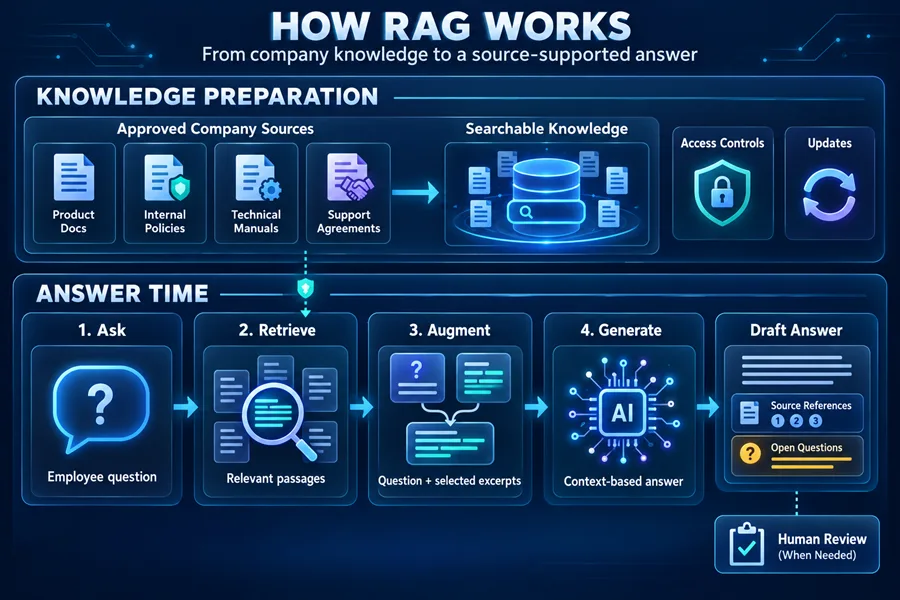
An updated document does not automatically mean an updated answer. The new version must be available to the search process, and some systems need to refresh or synchronize their searchable content first. RAG is not inherently a live connection to every change in a company's operations.
What Can Businesses Use RAG For?
The same approach can help wherever employees repeatedly need to find and interpret documented information:
- Employee onboarding: A new colleague asks how an internal process works. The assistant retrieves approved procedures and frequently asked questions, helping them locate the right guidance. The company must keep those documents current and restrict access to the appropriate teams.
- Internal IT support: An employee describes a common technical problem. The assistant finds relevant troubleshooting steps in maintained help articles. Finding an instruction is not permission to execute a potentially disruptive fix.
- Technical documentation: A service team asks about maintenance or equipment procedures. The assistant consults product manuals and service instructions, making lengthy documentation easier to navigate. Qualified personnel must verify any safety-critical recommendation.
RAG is especially relevant when useful answers are already somewhere in the organization's knowledge base but are difficult to locate and combine. It does not replace the need to maintain that knowledge.
RAG vs. Fine-Tuning: What's the Difference?
RAG gives an AI relevant information when it answers a question. Fine-tuning is additional training intended to adjust how a model behaves or performs a task. They address different needs and can be used together.
| Approach | Where the answer's information comes from | What changes | When it may help |
|---|---|---|---|
| General-purpose assistant without company-source access | Its general capabilities and whatever the user provides in the conversation | No dedicated access to business documents | General writing, brainstorming, or explanations that do not depend on current internal facts |
| RAG-enabled assistant | The question plus relevant passages retrieved from authorized sources | The context supplied for this particular answer | Questions that depend on maintained company documentation |
| Fine-tuned model | Its training and the information supplied to it at use time | The model's behavior through additional training | Tasks needing more consistent specialized responses or formats; up-to-date private facts still need a reliable source |
Neither RAG nor fine-tuning guarantees correctness. And they are not substitutes for access to a live business system. If an employee needs the current status of an ERP order or the exact inventory quantity right now, an authorized query to the relevant system may be more appropriate than searching stored documents. An application can combine that kind of system integration with RAG when both are useful.
What Are the Limitations and Risks of RAG?
Finding documents can make an answer better informed. It does not make that answer automatically correct, current, or safe to share.
The main risks are practical:
- The search may miss something important. The assistant might retrieve an irrelevant section or overlook a qualification in another document. A confident draft can then rest on incomplete evidence.
- The source material may be outdated or inconsistent. Superseded agreements, conflicting instructions, and documents that have not yet been synchronized can produce misleading answers. Someone must own updates and approved versions.
- The AI may misinterpret the evidence. It can combine passages incorrectly or reach a conclusion the documents do not support. Even a reference to a real document does not prove that the document justifies the statement.
- Permissions and privacy require deliberate controls. The application must enforce which sources each person can access, consider sensitive information and data transfers, and evaluate how external providers handle business data. Retrieved documents can also contain malicious instructions intended to influence the AI. Microsoft's guidance on input, context, and retrieval security explains why information brought into an AI system needs security controls.
- There is ongoing work and cost. Integrations, document preparation, search maintenance, testing, response time, and recurring service charges all affect whether the system is worth operating.
A document reference is a way to check an answer, not a guarantee that the answer is accurate.
In the sales proposal example, quoting the wrong support agreement could lead to an unsupported service promise, while revealing restricted contract terms could expose sensitive business information. In either situation, an assistant that states it cannot confirm a term is more useful than one that invents certainty.
When Should a Business Consider RAG?
RAG is worth evaluating when staff repeatedly ask questions whose answers depend on reliable, maintained company documents, and when seeing the supporting sources would help them make decisions. It is a weaker fit when the information is not documented, the required answer is an exact live transaction value, or access rules and review cannot be enforced.
| Consider RAG when… | Reconsider or use another approach when… |
|---|---|
| Employees need to search several approved manuals, procedures, or policies to answer recurring questions. | The task is a straightforward calculation or a fixed rule that conventional software can implement reliably. |
| The organization has maintained source documents, responsible owners, and clear access permissions. | Documents are untrustworthy, obsolete, or cannot be shared with the people or systems involved. |
| Staff benefit from a draft with traceable support and can review important claims. | The task requires an immediate authoritative value from a live system, or no meaningful human oversight is possible. |
A sensible first test is deliberately narrow: choose a small, maintained set of documents and a real category of recurring questions. Define who may see each source. Test not just easy questions with clear answers, but also questions whose answers are missing, outdated, conflicting, or restricted. Check whether reviewers can verify the proposed answers and whether the assistant actually helps with the work.
Expand only if that evidence justifies the additional maintenance and controls. A narrowly useful assistant is a more meaningful starting point than an ambition to make AI answer everything about the business.
Key Takeaways
- RAG finds relevant information and provides it to AI at answer time. It does not inherently retrain the underlying model on company documents.
- Its business value comes from using approved organizational knowledge, particularly when an answer depends on several maintained sources.
- Sources are not guarantees. Retrieval, interpretation, permissions, freshness, and human verification all matter.
- Start with a bounded problem and test it. Use live system integrations or simpler software when the task calls for them instead of document retrieval.